

Inside Zürich’s 169 West – “a unique animal” and double Gold Star winner

169 West, in Zürich, took two Gold Stars at Star Wine List of the Year Germany-Austria-Switzerland 2026, earning it a place in our Global Final for the second year in a row. We spoke to owner Kai Keong Ng about his wins, natural wine, and how to boost the longevity of hospitality careers.
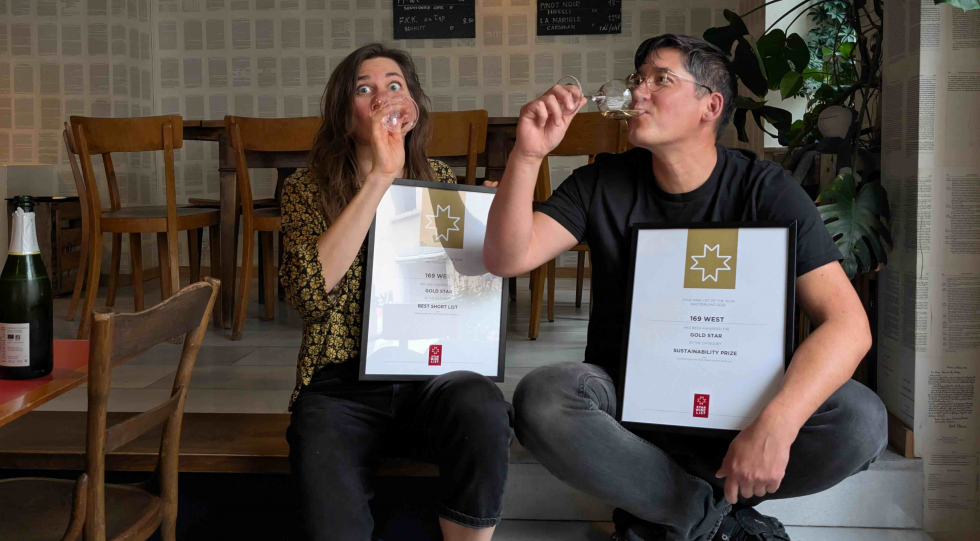
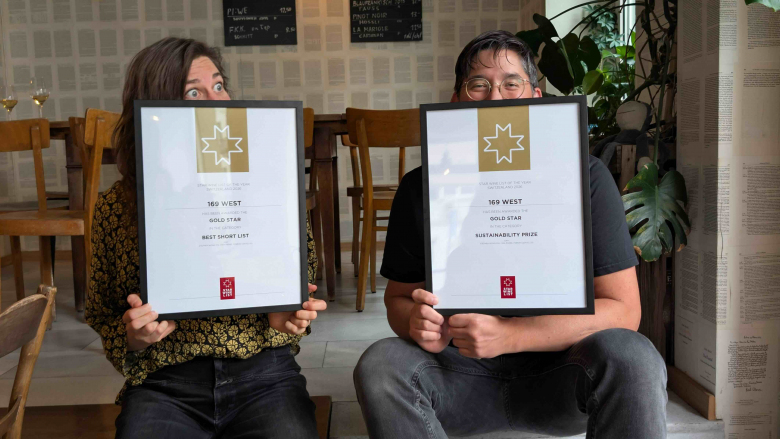
Kai Keong Ng, owner of Zürich’s 169 West, wasn’t able to attend our Vienna awards ceremony for Star Wine List of the Year Germany-Austria-Switzerland but, happily, when we spoke to him after the event, his two Gold Star certificates had just arrived – and were just asking to be photographed. Stay tuned to the bar’s Instagram page for the results, which is also where “Westies” can keep up with news and new wines hitting the list, which was recently named Switzerland's Best Short List, and took the country’s Sustainability Prize for the second year in a row.
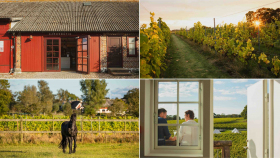
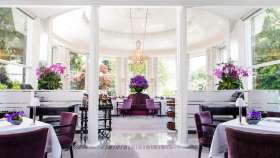
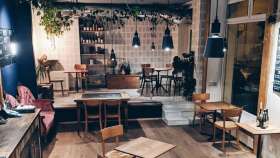
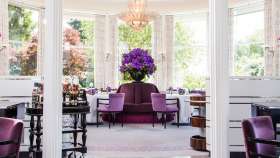
169 West is a coffee spot by day and a wine bar at night – the brainchild of Zürich-born Kai Keong, who admits that this “hybrid” model makes it “very hard to put words around where we fit in: daytime, you’re serving coffee and breakfast; in the evening you’re a wine bar. Weekends are all over the place with all the offerings.” The wine served is exclusively natural, at that.
Nonetheless, since opening in 2017, this bar has been a firm favourite among locals and a natural wine destination in its own right. “It’s a little bit of a unique animal,” says Kai Keong, who came to hospitality after a career in IT and financial services, and became enamoured by coffee.
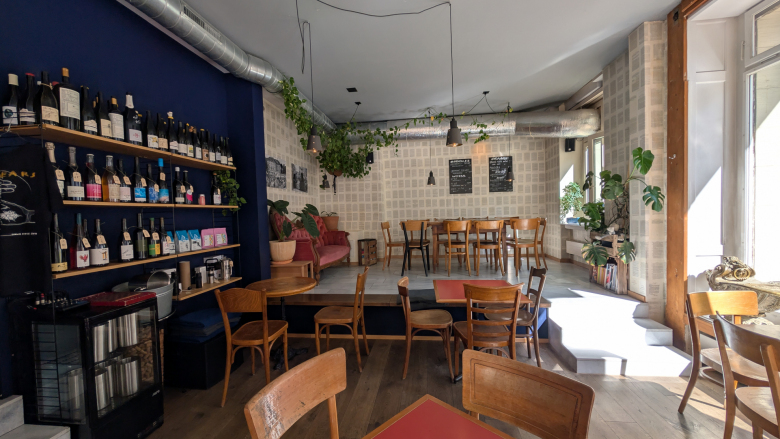
“I wanted to to create a place where you want to spend a Sunday or a Saturday, just having a coffee, having some nibbles, reading a newspaper; after a while, you go for a glass of sparkling, and then you meet some friends and you nibble a little bit more, and then you spend basically the whole day there.”
The concept stemmed from gut feeling more than anything.
“Obviously [providing] you don’t harm anybody, I just don’t care if somebody says, ‘You're stupid to open a natural wine bar.’ Back then, I just did it because I thought, ‘Yeah, this is what I want to do.’ And I think this is something very important in the philosophies of businesses – that you don’t let yourself be governed too much from the outside. So obviously, you adapt to your neighbourhood and your customer base and things like that, but in general, if you are not too mind-focused, I would say, go more from the stomach, from the heart, and then it can lead to some cool things and great things.”
Where natural wine makes sense
Coffee-focused Kai Keong “stumbled” across natural wine after sampling some during a ‘Slow Food’ tasting in Zürich, around 2015. “Before that, I was basically just not really big on wine,” he says. “And then I thought, hey, that’s actually pretty cool. It’s so different to other, conventional wines and, also, specialty coffee is so different to conventional coffee, that it could make sense to do something in the wine world. Coffee is a very cool product but, in the hospitality context, it’s very, very difficult to do a whole day of business out of it because, in the evening, you need something else. And coffee and wine just happen to have lots of similarities – from the farming, from the processing, and so on. So a lot of stuff you do in wine happens also in coffee. Also, the flavour universe is basically equal to coffee, if not greater. So the connection was kind of obvious.”
These days, the wine selection favours those that use minimal sulphur (whilst recognising that a touch can, on occasion, be necessary), come from biodynamically farmed vineyards as a minimum, engage spontaneous fermentation and, thereafter, are “as low intervention as possible – ideally, nothing added, nothing subtracted.”
Kai Keong explains that his and Lidia’s approach has to remain somewhat pragmatic, since context is so important when talking about which techniques winemakers have, or haven’t, employed.
“Lidia and myself, we struggle with fixed conventions because I think fixed conventions are always difficult. There are wines we have on the list which might be, in a very strict natural wine definition, not a ‘natural wine’ because it might have 21 milligrams of sulphur [added] at the end. So yeah, we are a bit more flexible, or fluid about it. We want to see terroir, we want to see also the winemaker’s signature in the wines.”
The wine list is hugely influenced by the bar’s regulars, who account for “at least 50 to 60%” of its guests, and so selections are made based on what the team understands its patrons are seeking, with suggestions welcomed from all.
“We don't really have titles,” Kai Keong says. “We actually don’t have a hierarchy in our business, so that’s sometimes a bit confusing – how the place is operated – but, basically, everyone can contribute wherever they want to.”
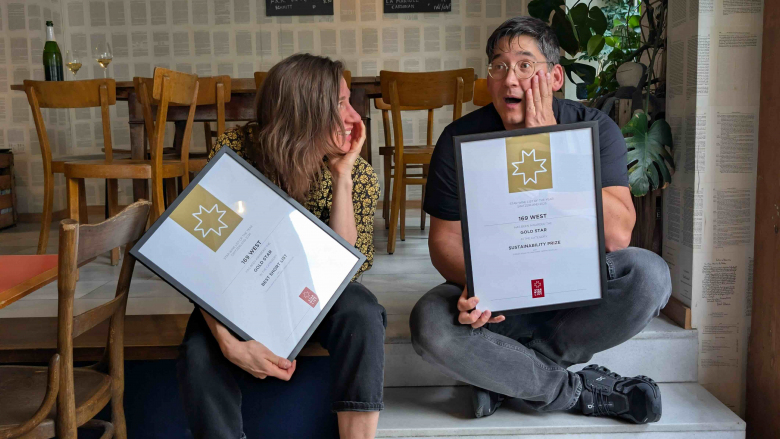
Two Gold Stars in 2026
The team effort in creating the wine list and intimate awareness of what guests want have helped tighten the selection, perhaps therefore explaining 169 West’s win in the Best Short List category for Switzerland, which rewards collections of under 200 references.
Judges’ comments: Best Short List, Switzerland
“A corner of free-spirited, natural, and idiosyncratic wine in Zürich, with a selection shaped by sensitivity and instinct. There is real pleasure in simply reading their boards, where deliciously chosen wines appear – and disappear – in constant evolution. At this wine bar, there is always something new, always movement, a continuous rotation that brings freshness and excitement to the experience.”
– Ferran Centelles
When it comes to sustainability, the concept took hold organically.
“We never set out to say, ‘Okay, we’ll make the most sustainable business.’ It was never an ambitious thing. It just felt right to find a structure which works for the world. We never set out to police people, but just did more of what we think is right. I find it very hard to describe it in a word because it’s very much a gut feeling – you do something and you just don’t feel well by doing it. For example, you throw away wines which you can’t pour anymore, which kind of feels wrong because a winemaker, he invested the whole year in producing that wine and you can’t serve it on the second day or whatever, then you pour it away, which just feels wrong. And I think this is the main driver to saying, ‘Hey, let’s find a way we could prevent that’ or ‘how can we make use of it and not waste it?’
“Then, hospitality is not a famous industry for working conditions, so how can you go about finding a work-life balance or finding a way that you can retain your people? Although it is a very stressful job and you work, sometimes, 10-hour shifts non-stop, how can you make a culture which supports the personal needs of employees? And you don’t feel bad asking people what they should do.”
Judges’ comments: Sustainability Prize, Switzerland
“There was resounding agreement from the jury to award this thoughtful establishment for how they are navigating the modern challenges of the restaurant and wine industries. Particularly commendable is their ethos, which remains at once holistic while being attentive to the details of every step along the supply chain, all the way through to training and continuous education.”
– Stephen Wong MW
In the case of wines past their prime, the team turns them into vinegar, or uses the reds in a signature lentil dish. Milk leftover from coffee-making is turned into yoghurt and labneh. “Basically, you just make a circular thing where you don’t waste a product, which has a lot of work in it.”
Up next
Unfortunately, Kai Keong is not free to attend the Star Wine List of the Year Global Final, in Sweden this June. But his Head Sommelier Lidia and Bar Manager Jennifer will be carrying the 169 West Flag at the grand conclusion of this season’s wine list awards tour – a welcome chance for the team to enjoy their national glory and recognition on the world stage.
“We are a very small, neighbourhood, low-key wine bar, I would say,” Kai Keong explains. “We do what we think makes sense for us, for society, for the community; also for the planet. And we never really seek attention in a sense – we just do what we do. And it’s always great if you get recognised for your work. Also on an international basis since, obviously, Zürich is a small city, and it’s competitive. But just to have the jury looking at your wine list and saying, basically, ‘It’s pretty cool and pretty great’ is always very, very nice for the team to hear.”
Otherwise, the summer for 169 West tends to be quiet since its cosy atmosphere attracts more guests in from the cold of winter than in the warmer months, when terraces are preferred. It will give Kai Keong and his team the chance to consider how the bar needs to evolve, with Kai Keong particularly preoccupied by finding a means of making hospitality an attractive – and feasible – job for people both to take up and carry on with beyond a certain age.
“How can the hospitality profession be shaped in a way that it is a long-lasting career path? Because what we see in our industry, especially in Switzerland, when people start into hospitality, is that they really like it at one point in time, they get burned out, they move away, they go into trade or something completely different. And I think most people choose hospitality mostly out of passion, and I think the industry needs a way to find options – how can this sustain? So what options do you have so that you still can do what you love to do? And how could a business – even a small business – retain the people with different opportunities?
“I don’t know how that should look – the thing is, I just don’t want to lose the good people because I see, almost every day, that the good somms stop because they just don’t want to push the floor anymore, or they move back into trade, but actually, they are very, very good in what they do. And I think it’s a shame that we, in the industry, don’t find some way to give other opportunities around it, to work.”
A small wine bar – and wine list – with big ambitions.
Search like a Pro – explore 3,500+ wine lists