

In her own words: Jancis Robinson MW on her life in wine writing
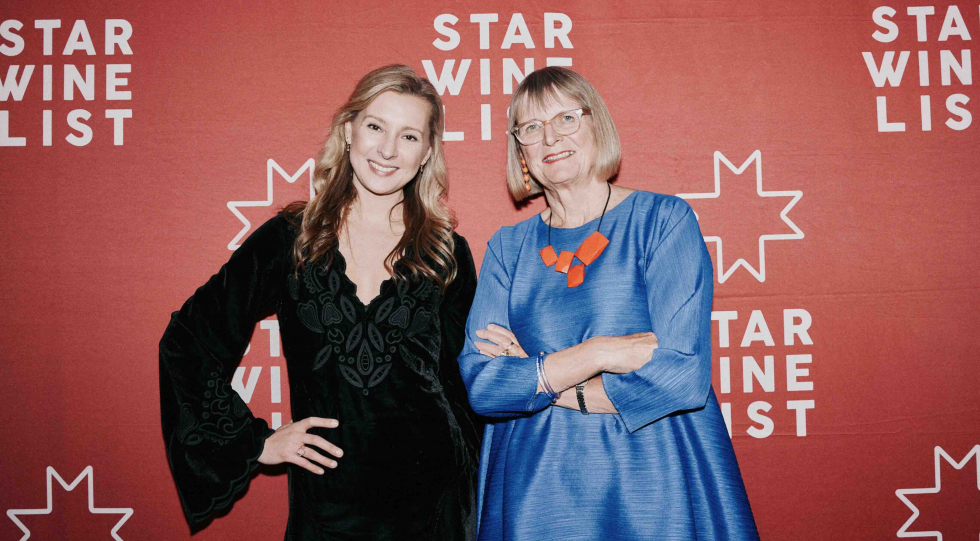

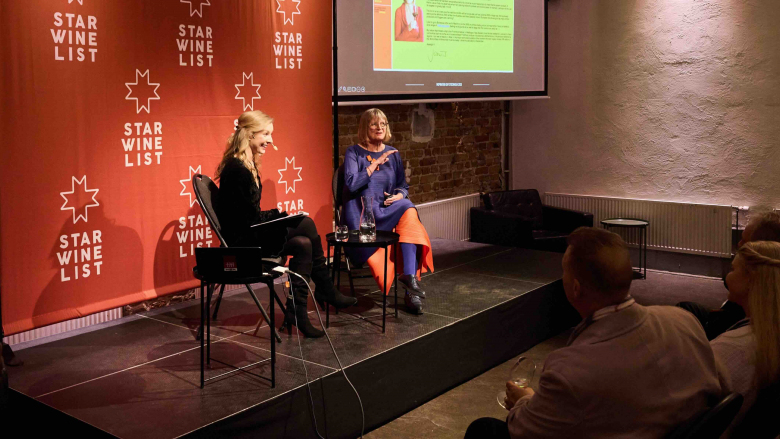
Master of Wine Jancis Robinson joined Star Wine List in Stockholm last month, to tell our audience about the 50 years she’s spent writing about wine. We discussed her upbringing in the north of England, her introduction to wine at Oxford University, that disagreement with Robert Parker, her own attempt at writing a wine list, and her views on the wine trends of today. Spoiler: discussions around natural wine are too polarised and tasting notes are, often, rather unhelpful.
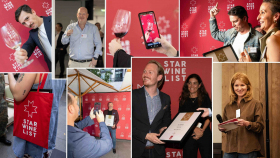
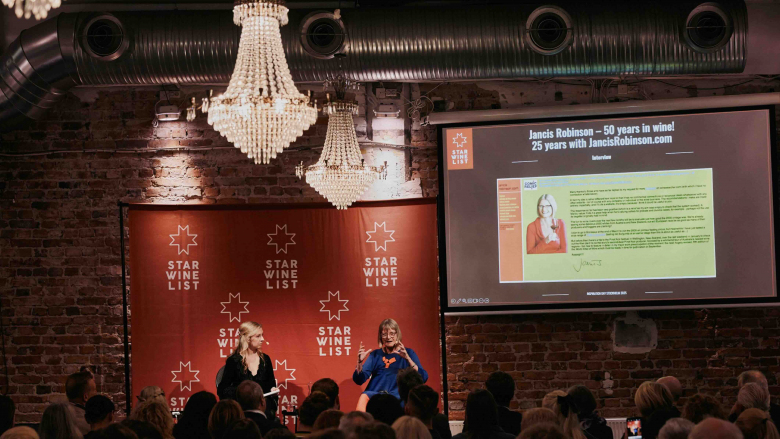
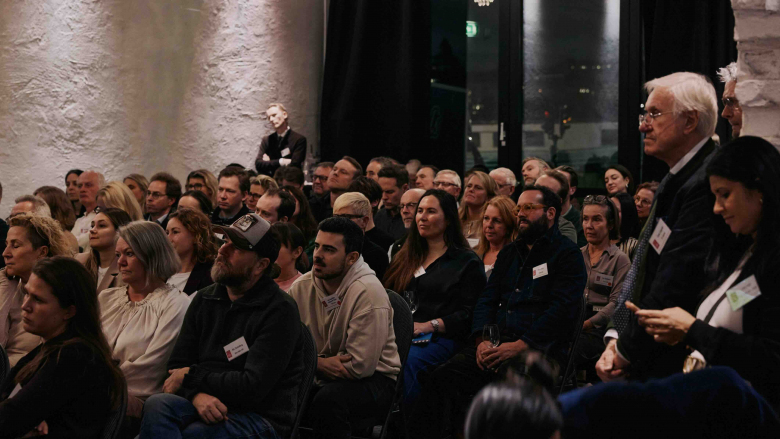
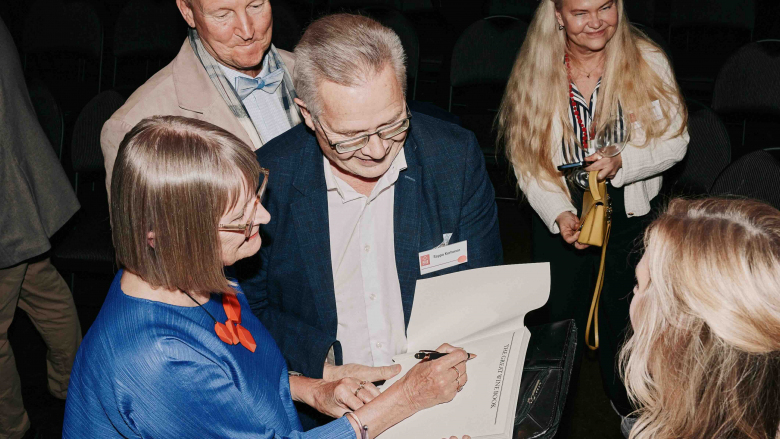
On Monday 10th November 2025, Jancis Robinson journeyed to Sweden to answer questions on her life in wine writing in front of an excited audience at Stockholm’s Skyddsrummet, as part of Star Wine List’s first Inspiration Day event. Anticipation was high for the Master of Wine’s first visit to Sweden in nearly 20 years. One audience member arrived armed with The Great Wine Book, which Jancis wrote in 1982, for the author to sign.
Over the course of an hour, Jancis delighted guests by discussing her 50 years in the business, 25 years of her website, JancisRobinson.com and how – any why – she became the first Master of Wine from outside the wine trade. We learnt that she failed to join the wine society whilst at Oxford University for fear it was full of snobs, attempted the Master of Wine after being likened to the Gamay grape in the press, had her head turned towards wine by a particularly lovely Chambolle and, arguably, had the last laugh after her rather public disagreement with Robert Parker.
Also, if people could stop watching her attempt to pour glasses from boxed wines at tastings, that would be greatly appreciated. And those reams of tasting notes you think are so insightful? They might not be helping at all.
Does she remember her most scathing review of all time? “Well, it’s wet.” A remark recalled with glee.
Here’s what else Jancis had to say, in her own words, as told to our Stockholm audience.
The voice of wine
I hope I’m fair. I say what I think and I’m not bound by being beholden to advertisers or sponsors, which is very, very important. I’ve never had any death threats. Maybe no one takes any notice.
Television is not a very good medium for wine because nothing actually happens. I used to wonder why, when we went filming, the cameramen got so excited when we got to the bottling line, which was the thing that we wine writers used to yawn about. But at last, here was some movement! The weakest point of any cooking show is the tasting bit, when the expert goes, ‘Mmm’. So tasting is not a spectator sport.
I wasn’t by any means unusual in being a female wine writer. I just put my head down and got on with it. In fact I benefited from it, because in the five years I was on the wine trade magazine, there was a lot of entertaining, a lot of lunches with visiting wine producers, and there was always a table plan. And, out of politesse, I was always sitting next to the wine producer, so I got the story! So I think I benefited more than suffered from being female in my role.
There’s been a fairly recent development in tasting notes. There used not to be tasting notes. A lot of them have become just long, long, long lists of flavours. It's quite common. And I'm no fan of that because I don’t think people get up in the morning and say, ‘The one wine I want to have today must taste of acacia blossom, wheelbarrows, melons, spices,’ and all that. I’m more keen to tell people, is it young? Is it old? Is it sweet? Is it acid? Has it got one strong characteristic? Where does it come from? That kind of thing.
I don’t think I had much authority to begin with. I got to a point at some stage where I look back at my earlier writing, envious, thinking I wrote so much more freely then, because I didn’t think anyone was really reading it.
The early years
When I was growing up, my mother kept a very warm bottle of Amontillado in the kitchen cupboard and very, very occasionally she'd have a sip of it, but only after she’d made the gravy. And my father was a big gin drinker. But it wasn’t until I got to Oxford that I met any of my contemporaries who’d been brought up with wine.
There was an Oxford University Wine Society when I was there, and friends who saw how interested in wine I was said, ‘Go and join that.’ And I said, ‘No, it’ll be full of snobs.’ If I had joined, I would have met my dear friends Oz Clarke, a fellow wine writer, and Charles Metcalfe – they were part of it. And I honestly think, if I’d joined them, they’d have knocked the stuffing out of me and I wouldn’t have had any confidence. They would have known more than me, and I probably wouldn’t have taken the path that I have.
Cumberland was a very agricultural place. I remember, as a family, going to what would now be called a gastropub and watching all the farmers eating steak with a bright yellow sticky liquid, which had been sold to them as Spanish Sauternes. And I suppose it was what we would call Moscatel.
Most of us who devote our professional lives to wine have an epiphany bottle, and mine was when I was at Oxford. It was a Chambolle Musigny Les Amoureuses 1959, which my boyfriend and I had chosen from the list because it sounded lovely. And I didn't know, at that stage, that with Burgundy it was important to look at the producer, but by deduction afterwards and working out who supplied that restaurant, which was Avery's of Bristol, I think it probably was de Vogüé. At the time, I was drinking mainly student plonk and this was just so different – the smell was so different, but the taste as well. And you did realise that there was history and geography and psychology, and science, and all that kind of thing in there.
For all how important the Judgment of Paris is seen today, there was no social media then and the results of that tasting came out very slowly. I don’t remember running a story about it on the trade magazine [Wine & Spirit], which we certainly should have done.
When I met Nick [Lander, husband and restaurant reviewer], he was about to open this restaurant with an all-American wine list. And I thought he knew what he was doing, but I now realise he absolutely didn’t. He was so lucky that it worked as well as it did. He was planning to go to America to buy wine for the restaurant and so I went with him, and we imported the first Oregon and Washington wines into Britain, as well as a whole array of Californian wines, because California became quite a big thing in Britain in the 1980s, when the dollar was weak against the pound.
Very early on in my son, Will’s career as a restaurateur, we went out to dinner and I spotted an unusual Chilean wine. It was when he only had one restaurant, and I rang him the next day and said, ‘I had this wine, I think it would be really good on the Quality Chop House wine list.’ And he said, ‘Ma! It’s on the list already.’ So I haven’t interfered since then.
Bordeaux wines
I haven't had nearly enough 1928 Red Bordeaux.
The 2003 Bordeaux vintage was controversial. It was the first heatwave vintage. Gérard Perse’s Château Pavie wine took things to an extreme of ripeness, alcohol, and oak, and I didn’t like it at all. Robert Parker loved it. I’d tasted it blind but he accused me of not tasting it blind, knowing what it was, and having a vendetta or a prejudice or whatever. We had, before then, been great mates – I’d been to dinner at his place at least once and vice versa; I wrote the first profile of him in the British press. It’s a good story, so everybody made an awful thing about this contretemps. And it was said there was an American view and a British view – it wasn’t just us: that all American critics agreed with Parker; all the Brits agreed with me. Anyway, I bumped into Parker in a Bordeaux hotel breakfast room, and we kissed and made up. And he said, very graciously, ‘That Pavie thing? I overreacted.’ So that was nice.
I think the best value in wine at the moment is probably petits châteaux Bordeaux because it’s a market that’s completely oversupplied. They can’t get a decent price for their wine, so it’s very, very inexpensive – for wines that are aged in barrel, limited yields, you know.
A Master of Wine
There is a move, quite rightly, to have refresher courses for Masters of Wine, which I think would be a very good idea.
I was seen as a populariser – kind of here today and gone tomorrow. There was an article written by a fellow journalist likening various British wine writers to grape varieties, and I was likened to Gamay. I love great Beaujolais, by the way, but I think that finally got me to say, ‘Ok, I’ll show you’ and that was one reason for having a go at the Master.
I’d have to work very, very, very hard to pass it today, and I don't do much blind tasting anymore. Particularly for the MW exam, blind tasting is like a sport – you have to be like an Olympic athlete and you practice, practice, practice. And I'm way out of practice. I haven't kept up. My sense of taste doesn't seem to have gone, but my memory definitely has, and I really don't think I could remember everything that I’d learned once I got into the exam room.
Wine trends over the years
To me, the most important duty of a wine is to refresh, rather than to clobber you over the head. And so I approve of the swing to lighter, fresher wines but I think there are some wines that are too light, too fresh, almost to the point of austerity or lack of fruit and interest.
I’m worried about the polarisation of natural wine, and that the vocal proponents bad-mouth the rest of wine. And I’m even more worried that a lot of people I know who are wine professionals, whose first natural wine was rubbish, think all natural wine is rubbish. And neither of those things, I believe, are true. I just don't want to sit in another Paris wine bar and get a sermon about how evil non-natural wine is.
I’m not sure that the Old versus New World debate will rage on. I think we’ve kind of passed that, not least because of the massive human traffic that there has been between the two. When I started, it was very rare for the children of French wine producers to go and get experience anywhere other than their own domaine. And even going to college was a newish thing. Today, it is absolutely routine for the next generation to go elsewhere – maybe another hemisphere, certainly another continent – to make really good friends there, cross-fertilise ideas. I think there’s been a wonderful exchange of tradition.
I’m always rather embarrassed at professional tastings, because I’m very pro wine in boxes – I think it's a very good idea, for sustainable reasons. They’ll have a box there but I don’t drink wine out of boxes that often, and I’m always very conscious that people are watching me using that tap: do I know how to do it?
I know many, many winemakers who were told by their owners to make wine in a style that was perceived to be what would get high points from American wine critics. And so that did change the style of wines – there were an awful lot of big, bold wines before and just after the turn of the millennium. Winemakers and wine drinkers often found these wines quite difficult to match with food, and they didn't necessarily age all that well. Now the people I would blame for this situation, incidentally, are not people like Parker and Wine Spectator because I’m absolutely certain they wrote what they believed, and I absolutely respect that. I blame the retailers who forgot what their role was, which was to select wines they personally liked, and explain and sell them to their customers. They just rolled over and said, ‘We don’t need to do that anymore. We’ll just put the points on and sell high-scoring wines.’ And that’s really why the scores got over-emphasised and winery owners wanted that style to be made.
I’ve been around so long that I’ve seen pendulums swing. When I started out, white wine was the thing – everybody wanted white wine. Then everybody wanted red wine, and now I see white wines coming back again. And of course, with the swing to these great big, oaky alcoholic wines, that’s been followed by a reaction, with a new generation of wine drinkers who absolutely don’t want that. And so we're seeing far more lighter, fresher wines where the terroir is allowed to speak – the vineyard rather than the cellar. But I wonder whether we will see a time when people get a little tired of lighter, fresher, and say, ‘Now’s the time for port.’ So it could swing back the other way, but not in the near future.
Sign up to our mailing list for news of the next Inspiration Day.
Search like a Pro – explore 3,500+ wine lists