

“I want to feel comfortable and genuinely welcomed,” says new Greece Ambassador Nena Dimitriou


Meet Star Wine List’s newest ambassador, Greek journalist Nena Dimitriou, an exciting (and excited) addition to our team. Here, we get to know the wine journalist as she adds her first nine Red Stars, located in the capital, Athens, in Tripoli, and on Crete, Rhodes and Santorini.
Writer Nena Dimitriou is originally from Piraeus, “the port city of Athens, but I’ve been living in the city centre for the past 13 years, and despite its challenges, I don’t think I could leave it soon.”
This spring, the Editor-in-Chief of Oinochoos and Vogue Greece writer joins Star Wine List as Greece Ambassador, and has nine new Red Stars for our guide to the best places for wine lovers to visit. Her biggest tip?
“Slow down. Greece is not Napa Valley. You don’t need to plan everything months ahead. Some of the best experiences come from simply stopping at a winery and finding the producer there, often out in the vineyard, hands-on.
“Despite its size, the country’s landscape is complex and mountainous, so distances can be deceptive – give yourself time to explore. Αvoid the islands in August. Local wine bars and village kafeneios are a great entry point, although with gentrification ‘hidden gems’ are becoming rarer. Athens, however, remains a year-round destination with a sweet, gentle climate with tonnes to explore.
“And if I may add: don’t rush to drink Assyrtiko too young!”
Get to know our new ambassador, below, and explore the updated guide to the Athens’ top wine spots.
Nena’s new Red Stars
¡Topa!, Athens
Amphibian, Athens
Botrini’s Santorini, Santorini
Daios Cove, Crete
Dionysos Restaurant-Wine Bar, Rhodes
Makris, Athens
Manari Taverna, Athens
Osteria Mamma, Athens
Villa Incognito, Tripoli
Welcome to Star Wine List! Are you excited to be joining our network of ambassadors?
“YES, YES AND YES! Cannot wait for the launch!”
When did you first get into wine?
“My family on my mother’s side is from Samos and, when I was a kid, my grandmother used to pour me a small cup of Samos Anthemis, a sweet Muscat, to keep her company during her afternoon aperitivo. I discovered wine at 18, while living on my own as a student, trying to cook risotto and following the rule of ‘cook with the wine you drink.’ It was a delicious Greek white, Roditis and Sauvignon Blanc, which opened the door. Spain came next, with many new wines, and then, as clichéd as it may sound (and I do love a good wine cliché), it was Assyrtiko from Santorini. End of story, or maybe the beginning.”
What do you do, right now?
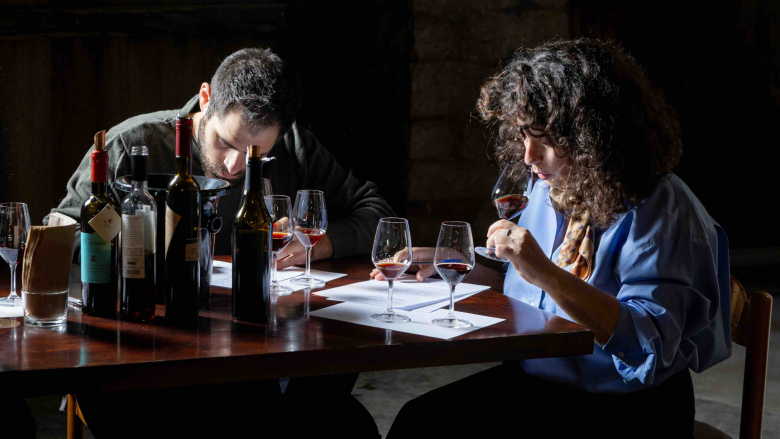
“As the editor of a wine magazine, I travel extensively to explore regions, grape varieties and the people behind them. Each issue involves tastings with a panel of sommeliers, where we review around 150 wines. I also hang around with wine people, everybody knows that wine people are the best people.”
Where do you live?
“I live in Athens, where the wine bar scene has evolved rapidly in the last two decades. There’s a strong mix of casual, character-driven spots and more focused wine restaurants, with an increasing emphasis on Greek vineyards.”

How did you go about choosing your first Red Stars?
“With a strong sense of responsibility! I focused on places I know well and have followed over time, including some of the more widely recognised venues. At the same time, I try to keep up with new openings and the evolving scene. For me, it’s not just about the length of a wine list, but its coherence, relevance, ability to reflect local vineyards. Clear points of view and reasons why were key criteria throughout.”
How would you describe Greece’s wine and hospitality scene at the moment?
“The overall quality of wine has improved significantly, yet there is a broader question, as elsewhere, about younger generations – whether they are drinking (enough) wine, and what the rise of natural wine ultimately means for the category.
“The pioneering generation of producers, who shaped modern Greek wine over the past decades, is gradually giving way to a new one, their children, who are stepping into the spotlight with a different, often more outward-looking and experimental perspective. There is a lot to look forward to, especially from those working with mountain vineyards.
“While the wine scene shows strong momentum and growing confidence, hospitality still has ground to cover. There is clear progress, particularly in terms of education, but further training and consistency are needed to reach higher international standards.”
How can a wine bar or restaurant impress you?
“I’m impressed by places where aesthetics and architecture feel true to their identity, especially when there is a meaningful connection to history or art. Don’t think of anything posh. It can be a tiny old kafeneio serving Marouvas on a rock overlooking the Aegean, or a bar in a Bauhaus building in Berlin. That said, I don’t look for impact alone – what matters most is a sense of ease. Whether it’s a casual wine bar or a fine dining restaurant, I want to feel comfortable and genuinely welcomed.”
Do you have any pet hates on wine lists, or in service?
“I’m not a fan of wine lists that rely on overly personal or vague categorisations – labels like “bold” or “easy” can feel reductive and don’t really help navigation (compared to grape or region).
“In service, I’m a bit afraid of the “this is my favourite” wine label. Taste is subjective – if Ι love listening to Rage Against the Machine and you to Bad Bunny, it’s unlikely we’ll share the same idea of a ‘favourite’ wine; I value recommendations that are tailored to the guest rather than the personal preference of the server.”
What's your favourite wine style (if you have one)?
“I’m drawn to high-acid sparkling wines with fine, persistent bubbles, as well as oxidative styles from the Jura. I also have a soft spot for the Greek Ro- varieties, Roditis, Robola and Romeiko.”
Is there any one section of a wine list that you make a beeline for, and why?
“I often make a beeline for the sparkling section, especially when I’m in the mood for something with high acidity and fine bubbles. I also love sections featuring oxidative styles or lesser-known regions, as they tend to offer more character and surprise.”
What do you think Greece needs more of, wine-wise?
“In Greece, indigenous grape varieties have been at the forefront for some time now – they are the most actively explored field, yet still feel exciting and, in many ways, exotic, even in their names: have you tried Kydonitsa, Petroulianos, Karapapas? It remains a largely unexplored landscape.
“At the same time, new expressions of Retsina, Robola of Cephalonia and sparkling wines from Greek grapes are gaining momentum. What the country could benefit from is a shift towards less oak-driven styles and perhaps more juicy, lighter-style reds, especially considering the diversity of local red varieties, a direction that aligns with international trends.”
How do wine lists differ on the islands as opposed to the mainland?
“For years, wine lists on the islands were heavily centred around Assyrtiko from Santorini, often featuring as many labels as possible. As this has become less sustainable, many island restaurants have broadened their selections, increasingly including wines from Greek mainland and regions like Crete.
“On the mainland, there is often a stronger focus on local producers, particularly from Northern Greece, Thessaly and the Peloponnese. In that sense, wine lists can feel more regionally rooted, in a positive way.”
Search like a Pro – explore 3,500+ wine lists